
On-Board Air
Having ARBs installed in my 95 Wrangler meant on-board air was not just a convenience for me. It meant air was a necessity. I originally used the electric ARB compressor for the lockers and to air up tires. After a couple of ARB compressor failures, I decided to change to a belt driven compressor. This page contains a description of my on-board air setup.
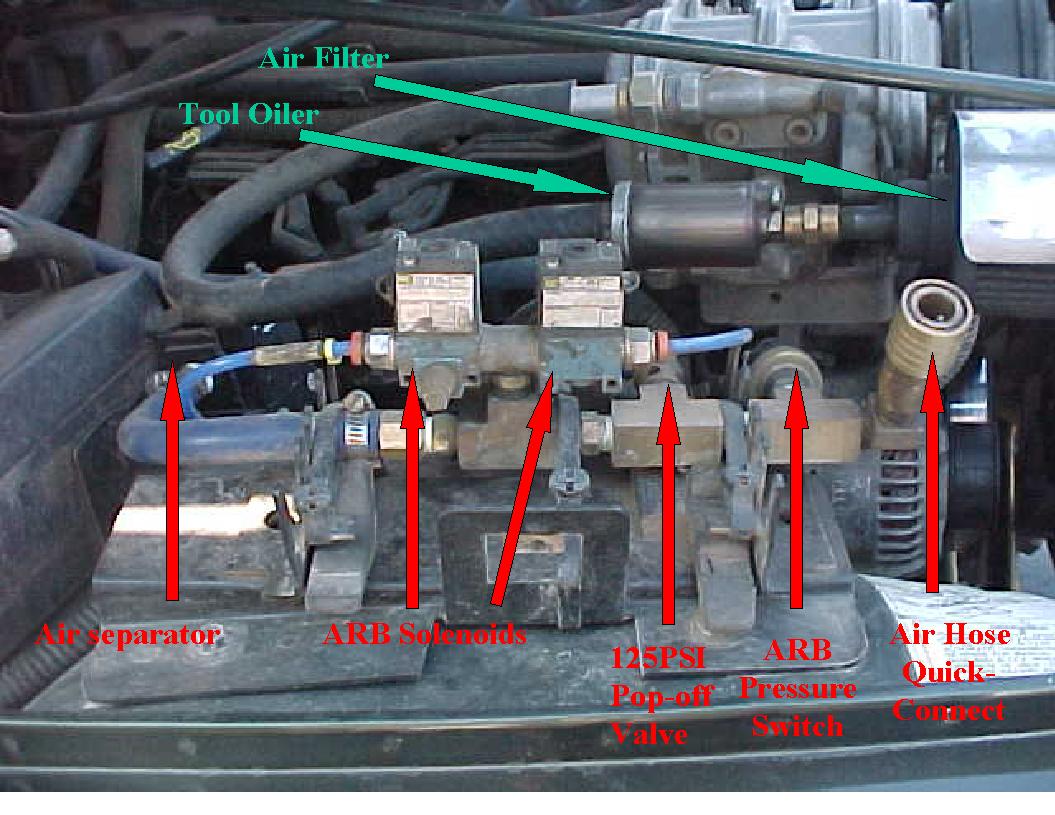
Air Compressor - The air compressor pictured above is from a Ford Mustang. While just about any air conditioning pump will work, I wouldn't necessarily recommend this one. The one pictured has failed and been replaced with another. The failure is not the reason I say this is not a good choice for a compressor. It's worked well actually and the failure was purely due to my neglect. I was running it very hard using a cutting tool to help out another Jeeper. I didn't realize I was out of oil and ran the pump dry. It seized with an awful noise. Once I got oil into it again, it did work well enough to run my lockers and air up tires. But it was noisey from then on and I just didn't trust it. The original was given to me and I was told it was from a Mustang. Unknown year. Well, I hit all the junkyards trying to find a replacement. I wanted to get the same one so I wouldn't have to fabricate brackets all over again. Now you'll find Mustangs in a junkyard. What you won't find is a Mustang engine. This is why I don't recommend this pump. Only because the engine is so popular, it's not going to be easy to replace.
Air Filter - The air filter pictured above is a K&N filter of some sort. Bud had it laying around in his garage so we used it. You certainly don't need anything fancy here. Most just use any cheap filter. I've even seen one fellow use a tiny little square filter element, with no cover or anything. Mine is mounted on a bracket that bolts to the compressor.
Tool Oiler - There are many kinds. The one pictured above is a ten dollar tool oiler and works just fine. I've since replaced the one pictures with a much nicer one, but in reality, the one pictured was easier to fill and tell when it needs oil. As far as the seal between the filter and oiler, don't worry. This is not high pressure so just a decent seal is necessary. Nothing like your output side. The filter and oiler do not have to be mounted together and can have a length of hose in between if you like.
Air Separator - In my case, this is simply a typical filter put on the output of a compressor. The same kind you'd have in your garage. The most inportant factor in the air separator is location. Ensure you have it not only filtering the air from your compressor, but also the air from any air banks or tanks you might have. Typically, air tanks develop moisture. If you're filtering the air into the tank, you're not preventing the condensation that develops in the tank from entering the rest of your system or tools.
Manifold - From the air separator a line runs to the manifold. The manifold as you can see in the first picture on this page is just a series of Ts. One T goes to the ARB solenoids. I have both solenoids connected together with a very small T, then that T is connected into the manifold. These solenoids are wired to switches in your dash. This is the control valve for air to your differentials. When they are "ON" the solenoids are open and allow air in. When they are "OFF" they close off air to the compressed side and vent the side going to the axle.
Pop Off Valve - This is purely a safety measure. Not absolutely required, but a damn good idea. In the event of a pressure switch failure, this device will vent if the pressure exceeds 125psi. It is purely a mechanical device and requires no wiring. Just a connection to sense the pressure.
Pressure Switch - The pressure switch pictured above came with the purchase of my ARB lockers. The hot wire to the compressor runs through this switch. When the switch detects pressure less than 85 psi, it closes and allows power to the compressor clutch. Once the switch detects 100 psi, it opens again and the compressor is turned off. Most people will use a pressure switch typically found on large compressors. The principle is the same except most of the switches are adjustable. The ARB switch is not adjustable.
Quick Connect - The last item you see pictured above is the quick connect. This is where I plug in air hoses. This was an easy place to put it. However, it can be inconvenient since you have to open the hood anytime you need air. I plan to add a connection to the exterior of the vehicle for convenience.
Al Bsharah (of Jeepaholics.com) has drawn
up a very nice block diagram of his air system. This should help
understand the big picture.
http://www.jeepaholics.com/tech/OBA/images/on-board-air.gif

Other sources of onboard air info:
http://www.onboardair.com
(Kilby Enterprises - The onboard air guru!)
http://www.jeepaholics.com/tech/OBA/oba.htm
(Al Bsharah)
http://home.san.rr.com/rambler/jaircomp.htm
(Bill Cue)